
Historic Craftsman Homes in Portland: Guide to the Rose City’s Favorite Architecture
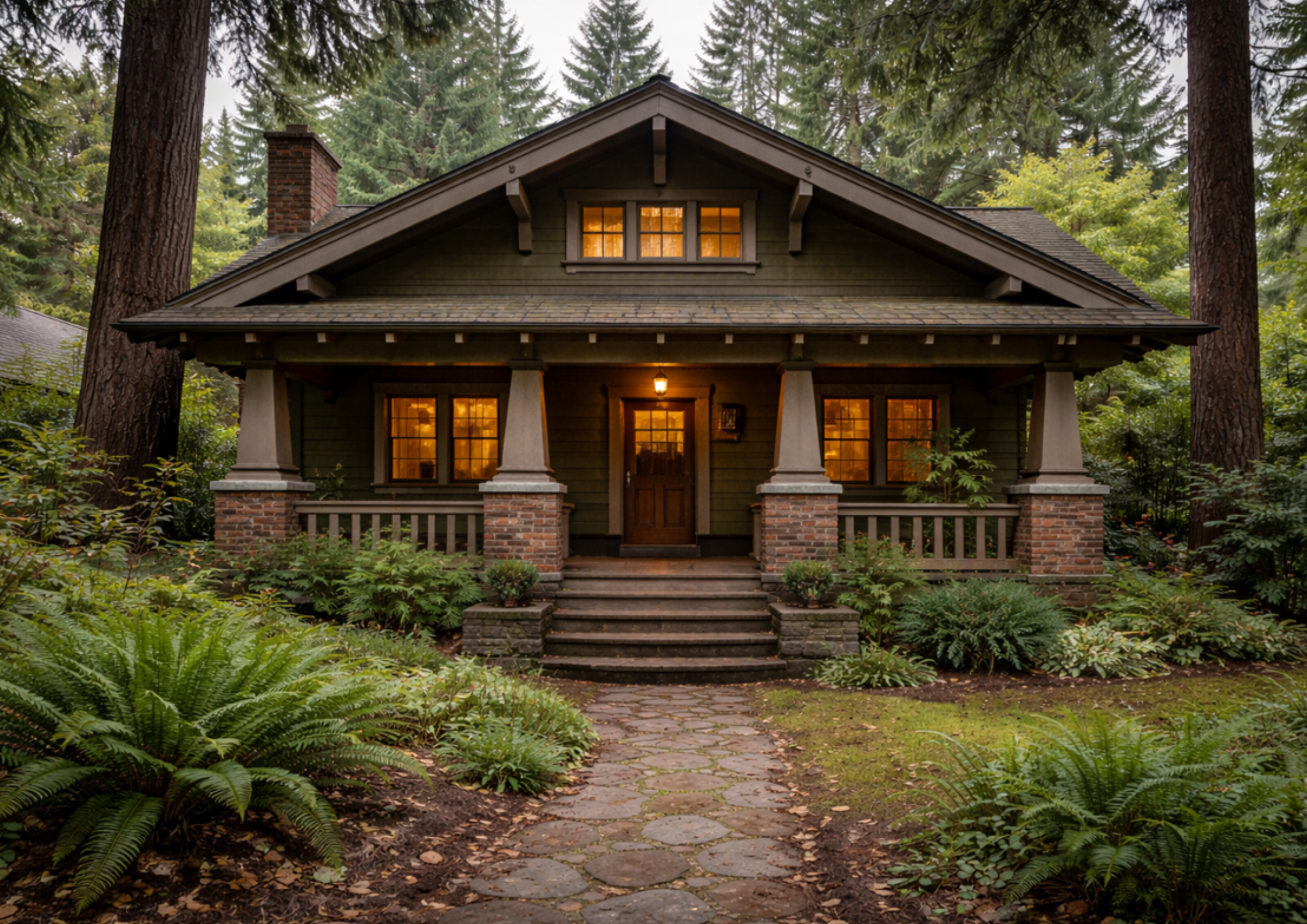
If you’ve spent any time walking through the tree-lined streets of Southeast or Northeast Portland, you’ve felt the pull of the Craftsman. There is something fundamentally Portland about a low-slung bungalow with a deep, sheltering porch that seems designed specifically for our drizzly afternoons.
While other cities may boast towering glass skyscrapers or sleek mid-century moderns, Portland’s heart belongs to the historic Craftsman style home. Today, these homes form the backbone of our most beloved historic districts.
Below, we’ll define exactly what makes a house a "Craftsman," explore the unique DNA of Portland’s local variations, and discuss how to preserve these works of art for the next century of Pacific Northwest living.
What is a Historic Craftsman Style Home?
To understand the Craftsman home, you first have to understand what it was fighting against. In the late 19th century, the Victorian era dominated architecture with its verticality, fussy ornamentation, and formal, compartmentalized floor plans.
A brief history
As the Industrial Revolution took hold, many felt that the soul of the home was being lost to mass-produced, factory-made millwork. The American Craftsman movement - an offshoot of the British Arts and Crafts movement - emerged as a radical return to basics.
It championed the idea that a home should be simple, functional, and, above all, built by the hands of a skilled artisan, not a machine.
A shift from the vertical to the horizontal
The philosophy was popularized by Gustav Stickley in his magazine, The Craftsman, which advocated for homes that were in harmony with their natural surroundings. This meant a shift from the vertical to the horizontal.
Instead of soaring turrets and steep peaks, the Craftsman style utilized low-pitched roofs and wide eaves that made the house feel grounded and stable. The goal was honesty in construction: if a beam was needed to hold up the roof, that beam should be visible, beautifully finished, and celebrated as a decorative element in its own right.
While the movement was national, it found its most fertile ground here in the West. Because these homes were designed to be built with local materials, the "Portland Craftsman" became a distinct breed, heavily influenced by our state's massive timber industry and our unique relationship with the outdoors.
These are reflections of a time when the "good life" meant sitting on a wide porch, surrounded by hand-carved wood, watching the neighborhood go by.
The Anatomy of a Portland Craftsman: Features and Hallmarks
While every Craftsman is unique, the style is defined by a specific kit of parts that makes them immediately recognizable.
In Portland, Oregon, these features were elevated by the abundance of high-quality old-growth lumber that was available during the early 20th century.
Here are the core elements that define the anatomy of these historic treasures.
The Iconic Front Porch and Tapered Columns
The most recognizable feature of a Craftsman is the wide, covered front porch.
Unlike the tiny stoops of the Victorian era, the Craftsman porch was designed as an outdoor room or a transitional space that bridged the gap between the private home and the public street.
These porches are almost always supported by heavy, tapered columns (often called “elephant legs") that rest on massive piers of stone, brick, or stucco. This gives the home a sense of permanence and heaviness that is a hallmark of the style.
Low-Pitched Gable Roofs and Deep Eaves
1900 to 1920s Craftsman houses are characterized by their rooflines. Most feature a low-pitched gable or hip roof with wide, overhanging eaves. In Portland’s rainy climate, these deep overhangs serve a dual purpose: they protect the siding and windows from the elements while creating a cozy, sheltered feel.
Look closely under the eaves, and you’ll see exposed rafter tails and decorative knee braces. These are a visual reminder of the home’s structural integrity.
Built-in Everything: The Philosophy of Efficiency
Once you step inside a Portland Craftsman you’ll notice that the furniture is literally part of the architecture. The Arts and Crafts movement believed in "a place for everything," leading to an explosion of built-in features.
This includes window seats in the living room, china buffets with leaded glass doors in the dining room, and built-in bookcases that often flank a prominent fireplace. This was a revolutionary way to make smaller floor plans feel grand and highly functional.
Douglas Fir and Local Woodwork
In the Midwest, Craftsman homes might use oak; in Portland, Douglas Fir is king. Because Portland was a timber hub, builders here could afford to use wood extravagantly. This resulted in the stunning box-beam ceilings (where large beams create a grid pattern on the ceiling) and high wainscoting that lines the dining room walls.
Often, this wood was left with a dark, natural stain to highlight the grain, which is a stark contrast to the painted trim common in modern builds.
Hand-Pressed Tile and Leaded Glass
The "Arts" in Arts and Crafts showed up in the smaller details. Many Portland Craftsmans feature fireplace surrounds made of Batchelder tile - hand-pressed, earthy tiles with subtle geometric or nature-inspired motifs.
You’ll also find leaded glass or even "Povey Brothers" stained glass windows (known as the "Tiffany of the Northwest") that add a layer of kaleidoscopic light to the interior without sacrificing privacy.
Portland’s Craftsman Corridors and Where to Find Them

Portland’s rapid expansion during the early 20th century perfectly intersected with the peak of the Arts and Crafts movement.
As the streetcar lines moved east from the Willamette River, these neighborhoods became the testing grounds for the finest Craftsman architecture in the country.
Today, each offers a slightly different take on the style.
Ladd’s Addition
Perhaps Portland’s most famous historic enclave, Ladd’s Addition is known for its unique wagon-wheel street plan and its stunning collection of high-end bungalows.
Here, you’ll find some of the most intricate examples of leaded glass and short-stout tapered columns in the city. The homes here were built with a high degree of architectural continuity - a "must-walk" for any Craftsman enthusiast.
Laurelhurst
If Ladd’s is the home of the bungalow, Laurelhurst is the home of the Craftsman estate. Known for larger, often two-story residences, this neighborhood features grander Airplane-style Craftsmans (named for their wide, wing-like second-story dormers) and massive porches.
Many of these homes were built for the city’s early elite and feature some of the most impressive box-beam ceilings in the Pacific Northwest.
Irvington
In Northeast Portland, Irvington offers a blend of grand Craftsman bungalows nestled alongside Tudors and Colonials. The Craftsmans here are often more formal, featuring larger foyers and expansive sleeping porches designed to catch the summer breezes off the Columbia Gorge.
Sellwood-Moreland
For a look at the quintessential working man’s Craftsman, Sellwood is the place to be. These homes are typically smaller, 1.5-story bungalows that prove you don’t need a massive footprint to have incredible character. They are the heart and soul of Southeast Portland’s residential charm.
Remodeling a Portland Craftsman: Honoring the Handiwork
When talking about remodeling a historic Craftsman-style home, the goal is invisible modernization.
That is, you want the luxury of 2026, but you want it to look like it was installed in 1912. At Revive Works Remodeling, we approach these projects with a preservation-first mindset.
Invisible Modernization
One of the biggest challenges is integrating modern technology, such as high-velocity HVAC or smart home wiring, without cutting into original fir wainscoting or plaster walls. We specialize in routing modern utilities through dead spaces and using period-accurate trim to hide the evidence of 21st-century comfort.
The Kitchen Conundrum
Original Craftsman kitchens were usually small, utilitarian spaces tucked away at the back of the house. Today’s homeowners want open, social hubs.
The trick is to use materials like soapstone counters, subway tile with dark grout, and shaker-style cabinetry that honors the "honest" aesthetic of the era while providing professional-grade appliances and storage.
Seismic Retrofitting
In Portland, the safety of your historic home is just as important as its beauty. Most Craftsman homes sit on unreinforced masonry foundations. A critical part of any major remodel is a seismic retrofit: bolting the house to its foundation to make sure it remains standing for another century.
Final Thoughts: Living in a Work of Art
Owning a historic Craftsman means you never have to go looking for character. It’s already built into every mitered corner and hand-forged hinge of your home. These houses weren't just built to be lived in but to be admired, and it’s the reason why they require a specialized touch and craftsmanship to stay healthy in our modern world.
Whatever the case, you need a partner who speaks the language of Douglas Fir and tapered columns. Don't let your home's heritage be remodeled away by someone who doesn't know a rafter tail from a tailpipe.
If you’re ready to start your remodeling journey with an artisan, historic Craftsman style home specialist in Portland, OR, contact Revive Works Remodeling today. Let's make sure your home remains a masterpiece for the next hundred years.
Let's Talk About Your Project
From small fixes to full renovations, we treat your home like it's ours. Portland-based, reliable, and actually easy to work with.
Contact Us